Why Your Foundation Turns Orange By Noon
You put it on at seven. It looked right.
By lunchtime you catch your face in a window or a car mirror, and it's gone warm on you. Oranger. A little off from your own neck.
Here's the answer, before anything else:
It isn't a bad tube. It isn't your technique. Your skin changed, and the color in that tube has no way of knowing.
That's it. That's the whole thing. Everything below is just the detail — what's actually happening on your face, the five things that help, and the one question none of it answers.

What's actually happening
The pigment in your foundation sits on your skin all day. It mixes with your own oils, your warmth, the air. Over a few hours that reaction can shift the color — usually warmer, usually more orange. Perfect match at seven. Different color by noon.
Two things make this worse after 45, and nobody tells you either one.
Your skin's oil and pH change with hormones. The same formula that behaved one way at 35 behaves differently on you now — same tube, same shade number, different result.
And drier skin holds pigment unevenly. So the shift doesn't happen smoothly across your face. It goes patchy. Heavier where you're dry, lighter where you're not.
So the shade that was right for twenty years quietly stops being right, and it's not gradual enough to notice on any single morning.
Nobody warned you about this part either. When Galderma surveyed more than 4,300 women aged 45 to 60 across nine countries — presented at the IMCAS World Congress in Paris this January — over half said they only learned menopause affects the skin by going through it themselves. The American Academy of Dermatology has said it plainly for years: as hormone levels fall, skin gets drier, thinner, less firm, and tone shifts with it.
That's not a technique problem. That's not you.
Five things that actually help
1. Judge it at hour six, in daylight
You decide about a foundation in the first thirty seconds — the one moment almost everything looks fine — standing in a bathroom, under lighting built to flatter you.
Both of those are lies.
The shade you're actually wearing is the one on your face after a full day, in real light. So: put it on, live your day, and around lunchtime step outside into the shade and take one photo. Front camera, no filter, jaw and neck in the same frame.
Two minutes. You'll know something a mirror will never tell you. Do it to every foundation you own.
2. Fix the dry patches before you blame the color
Dry patches grab pigment and hold onto it. It reads as a color problem — a dark spot, a rough spot, somewhere it went weird on you — when it's really texture wearing a color costume.
Moisturize, then actually wait three to five minutes before anything else touches your face. Most women wait about forty seconds.
3. Your undertone moved too
Everyone matches depth. Almost nobody rechecks undertone, because for twenty-five years it never moved.
Hormonal change shifts tone, not just dryness. A foundation that's the right depth but the wrong undertone is exactly the one that reads fine in the mirror and orange in daylight — because the mismatch only shows once the pigment warms up on you.
4. More shades was never the fix
In 2017 Fenty launched with 40 shades and the industry chased it. MAC went past 60. Make Up For Ever went to 50. There are matching apps now, and quizzes, and AI shade finders.
And women still can't find their shade. The trade press says it out loud: despite all the new technology, consumers still struggle to match.
Stop and ask why.
Going from 6 shades to 50 is a finer ruler. It measures you more precisely, on one morning, in one light. It still hands you a number that's fixed forever — for a face that isn't.
5. Which is why you end up with two bottles
This is where most women land. A summer bottle and a winter bottle, blended on the back of your hand each morning to get somewhere near whatever your skin is doing that week.
It works. It also costs two full-price bottles instead of one, and ninety seconds every morning mixing your own face color by hand, like you're standing at a paint counter doing a job the factory should have done.
Now look at that list again.
Every one of those is a workaround. Tests you had to invent, bottles you had to buy in pairs, a skill you had to develop — all to compensate for one thing.
The color in your tube was decided in a factory, months before it met your face. Once it gets there, it cannot adjust.
Which raises the question none of the five answer:
Why does the color have to be decided in advance at all?
It turns out it doesn't
Korean formulators answered that differently. Don't put a finished color in the tube. Put the color somewhere it can't mix until it touches her face.
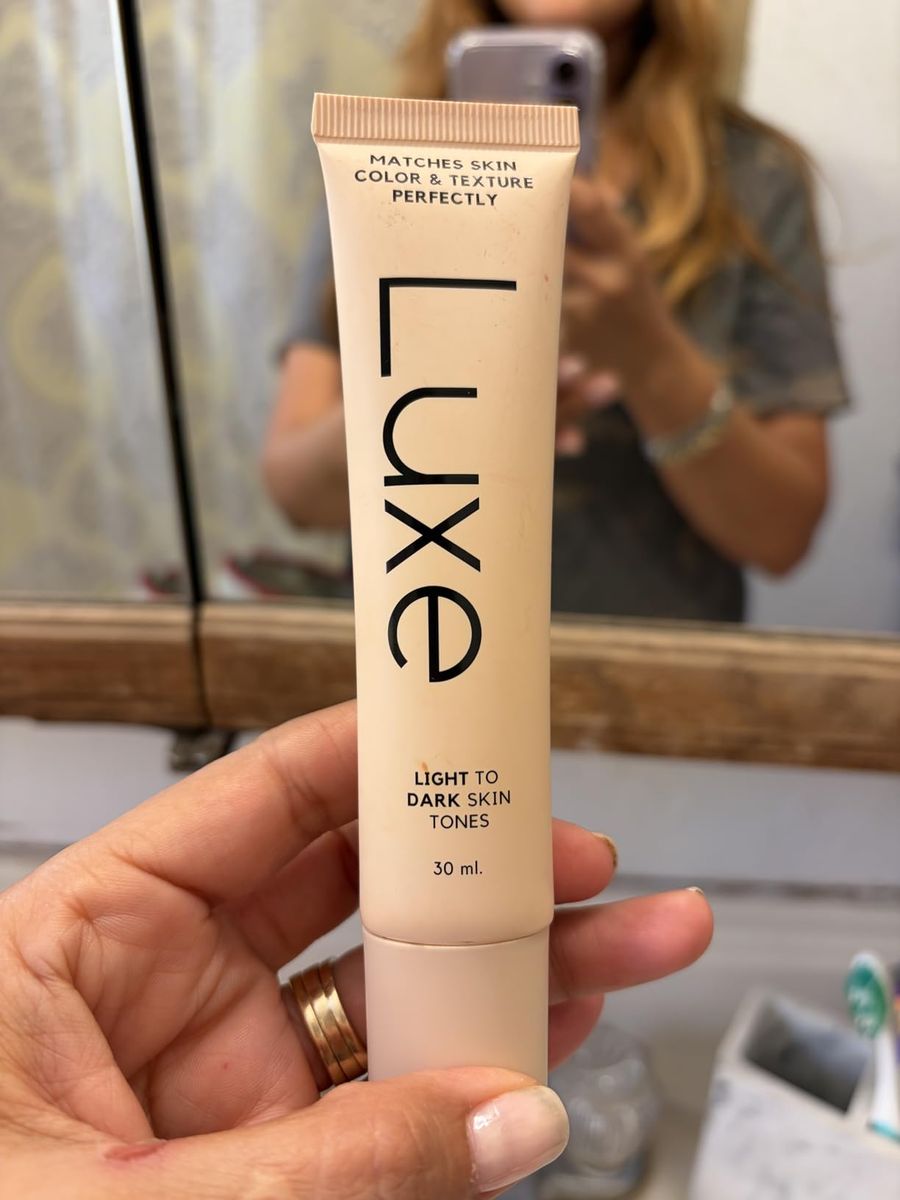
The cream comes out white.
The color is in there — sealed inside thousands of microscopic beads. Picture tiny water balloons, each holding yellow, red, or neutral pigment behind a thin shell. As long as the shells stay intact, nothing mixes and nothing shows. That's why it looks like white cream in the tube and on the back of your hand.
Then you blend it in. The friction of your fingers and the warmth of your skin break the shells open. The pigment spills out and mixes right there — on your face, against your tone, this morning. Thirty to sixty seconds and the white is gone.
Watch it happen and the claim stops being a claim.
Here's why "one tube" isn't the thing you've heard before. It isn't picking a shade from a range and hoping. There is no finished shade until your skin makes one. The same tube comes out differently on different women, because it's mixing against them rather than selecting from a list.
Not a color someone chose for you a year ago. Your color, mixed on you, today.
And because it re-mixes at every application, it follows you. Through seasons. Through hormone shifts. Through whatever your skin does next year.
It's sold as Luxe Color Changing Foundation.
And that phrase probably just did something to you
Good. It should.
You've seen color-changing foundation before. It was a Facebook ad. It came out white and stayed white. Or it came out in orange blotches. Or it gave no coverage at all and smelled like sunscreen. Or — this happened to a lot of women — you paid, nothing arrived, and nobody answered your emails.
That's TLM and the dozen clones behind it. The mechanism was real. The companies weren't.
So here's what's different, stated plainly, so you can check rather than trust:
It has actual pigment in it. The complaint about the cheap ones is that they're tinted moisturizer with a gimmick. This is buildable light-to-medium coverage — real product, not a color trick.
It's formulated for skin that creases. Light and flexible, built to move with skin rather than set hard on top of it. Rated for 12-hour wear.
It ships through Amazon. Not a checkout page you've never heard of, not a card saved with a company overseas. Amazon's warehouse, Amazon's tracking, Amazon's returns.
It comes in three ranges, not one. Light, Medium, Medium-Dark. You pick the range, the pigment fine-tunes inside it. Anyone claiming a single tube covers every woman on earth is selling you something — if you're extremely fair or deeper than medium-dark, this range may not reach you, and you should know that before spending a dollar.
What it won't do
It's light-to-medium coverage. If you want full-glam, can't-see-a-freckle coverage, this isn't your product and you'll be disappointed. Buy the heavy stuff for that.
What it's for is the other days. The ones where you want to look like yourself — rested, even, recognizable — and then stop thinking about your face until you take it off.
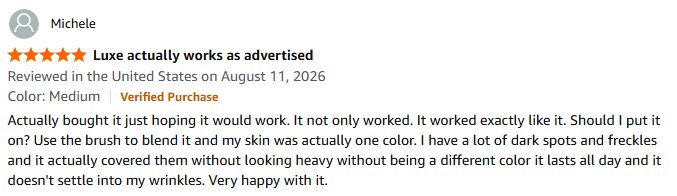
From women who've worn it



You can't lose money on this
This matters more than everything above it, because you've been burned and you're not moving without it.
No subscription. No auto-ship. No card saved with a brand you've never heard of. One-time purchase through Amazon, which means returns run through the same process you've already used a dozen times. You don't email anyone and hope they write back.
So you're not deciding anything right now. You're running a test.
Put it on. Live a normal day. At lunchtime, step outside and take the photo — jaw and neck in the frame, no filter. Exactly what you'd do to any foundation.
If your skin says no, send it back.
The real cost of waiting
There's no countdown on this page and there won't be one.
The actual math is simpler. Every morning this stays unsolved is another morning mixing two bottles on the back of your hand to approximate a color that used to just come out of a tube. Another noon catching your face in a window and not liking what the light did to it.
That's the price of waiting. Not a timer — just more of the same mornings.
The button opens the Amazon listing. Pick your range — Light, Medium, or Medium-Dark. It arrives, you run the daylight test, and in one day you find out something twenty-five years of shade numbers never told you.
Your color. Mixed on you. This morning.